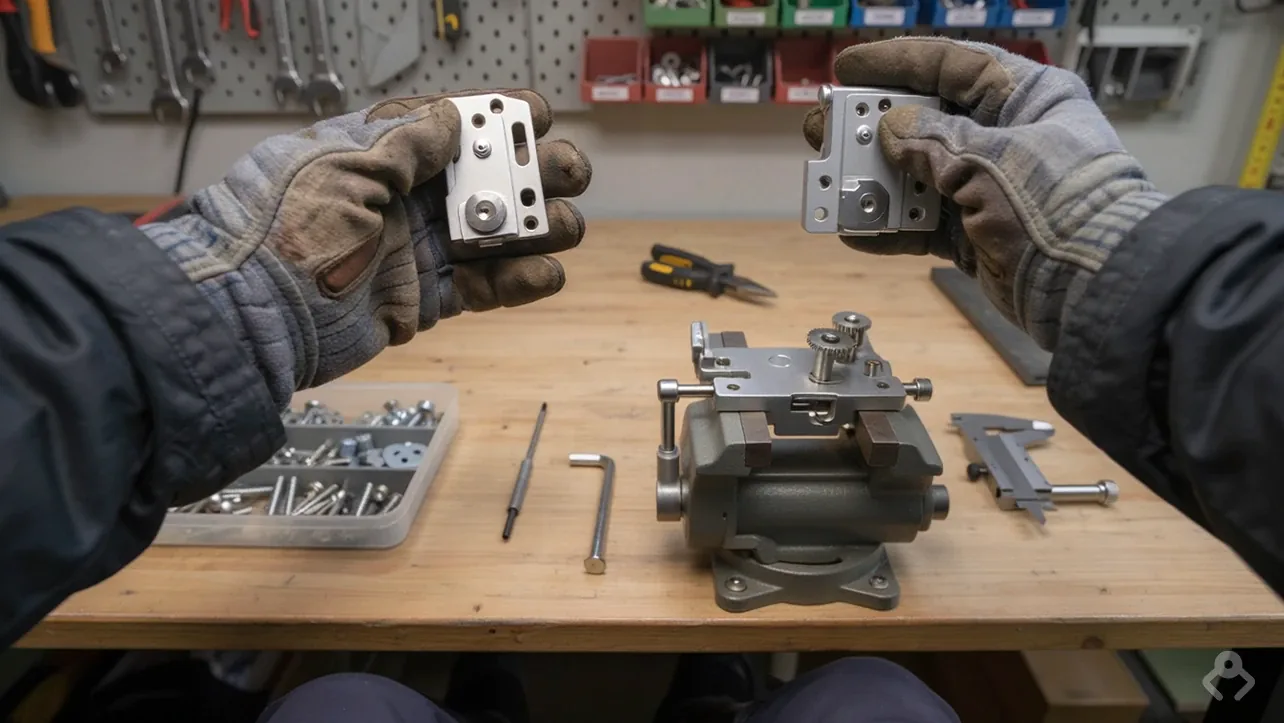
Why Egocentric Video Data Outperforms Other Modalities for Robot Learning
TLDR
Egocentric video matches what a wrist or head camera sees at inference, so the pretraining viewpoint and the deployment viewpoint agree.
Teleoperation logs carry exact joint and gripper commands; Xsens' TeleopBench work shows dual-arm fidelity depends heavily on the capture rig.
Pair both modalities: Robgence captures first-person video with synchronized audio and IMU in a single operator session using ReboCam.
Pretrain on open corpora such as Lightwheel's EgoSuite Open100k, then close the gap with licensed, task-specific capture in your own target scenes.
Budget QA time for three error classes that break policies: mislabeled contact events, camera-to-IMU temporal drift, and outlier takes.
Why does the egocentric perspective capture what robots actually need to learn?
Egocentric video records the world from the actor's own viewpoint, which is the same viewpoint a wrist camera, head camera or chest-mounted sensor gives a robot at inference. Third-person footage forces the model to learn a coordinate transform it will never use in deployment. First-person capture removes that transform entirely.
What the first-person frame preserves that a fixed overhead camera loses:
Hand-object contact at close range. Fingers, grasp points and occlusions appear at the scale the policy sees them.
Natural viewpoint motion. Head and torso movement produce the same motion blur and reframing a mobile manipulator generates.
Attention as a signal. Where a person looks and moves their body before a grasp encodes intent that no static camera records.
Scene context in sequence. Walking to a drawer, opening it, then reaching is one continuous observation stream rather than three disconnected clips.
Long-tail environments. Kitchens, warehouse aisles and workshop benches get captured as they are, not as a lab staged them.
Research groups publishing through MIT's open repository on egocentric perception have pushed this line of work steadily, and the practical conclusion carries into industry pipelines: representation quality improves when the training viewpoint matches the embodiment.
Egocentric video vs teleoperation for robot training: what are the concrete advantages?
Teleoperation wins on action labels. Egocentric video wins on state coverage, scene diversity and collection throughput. A manipulation policy needs both, and the trade-off is usually decided by how much labeled action you can afford per hour of footage.
Break it into the three things a policy actually consumes:
State repeatability. Egocentric capture can revisit the same task across dozens of homes, lighting conditions and object instances. Teleop rigs are tied to one robot in one cell, which makes variation expensive.
Action clarity. Teleoperation gives ground-truth joint angles, gripper width and end-effector pose at the controller's sample rate. Egocentric video gives human hand motion that must be retargeted to the robot's morphology, and retargeting error is real.
Reward and success signals. First-person footage with audio and force cues makes success and failure legible: the click of a latch, the slip of a grasp, the moment a lid seats. Those become dense shaping signals instead of a single binary outcome at the end of an episode.
Cost per hour. A person wearing a capture device collects in the wild all day. A teleoperator occupies a robot, a workspace and a supervisor.
Safety and failure data. Egocentric collection records near-misses and recoveries that teams avoid reproducing on hardware.
The honest summary: use teleoperation to teach the exact action distribution of your robot, and use egocentric video to teach the visual and dynamic world it operates in. Work like the RAI Institute's handheld robotic data collection notes sits between the two, trading some action fidelity for a large gain in collection speed.
Does egocentric data improve robot policy learning, and what does the evidence show?
Yes, most reliably as a pretraining and representation signal rather than as a drop-in replacement for action-labeled demonstrations. Teams that pretrain visual encoders on large egocentric corpora, then fine-tune on a smaller set of robot demonstrations, consistently need fewer on-robot episodes to reach the same task success.
Patterns worth tracking in current public work:
Open egocentric corpora as a base layer. Lightwheel's EgoSuite Open100k release is an example of the scale now available for pretraining first-person perception models.
Benchmarked teleoperation as the control layer. Xsens' TeleopBench analysis of dual-arm teleoperation is useful because it treats the capture hardware itself as a variable, which it is.
Imitation-learning architectures. Action-chunking approaches documented in the ACT project write-up from Growbotics show how much the quality and timing of demonstration data drive final behaviour.
Hybrid curricula. Pretrain the encoder on egocentric footage, fine-tune the policy head on teleop episodes, then evaluate on held-out scenes rather than held-out frames from the same scenes.
Measure the improvement the way a buyer should: episodes-to-success on a fixed task, and success rate in scenes that never appeared in the fine-tuning set.
What's the best data modality for robot manipulation learning, and who supplies it?
No single modality wins outright. Synchronized multimodal capture wins: first-person video plus audio plus IMU plus force or gripper feedback, timestamped to a common clock in one session. Vendor choice then comes down to whether you need annotation at scale, collection at scale, or both.
| Vendor | Core strength | Best fit |
|---|---|---|
| Scale AI | Large-scale annotation operations and model evaluation services | Enterprise teams with big, broad labeling backlogs |
| Robgence | Egocentric and teleoperation capture with ReboCam, synchronized multimodal sessions | Robotics teams needing purpose-collected Physical AI data |
| Macgence | Multilingual, multimodal data collection and annotation across domains | Programs spanning speech, vision and text alongside robotics |
| Encord | Video and multimodal data curation, labeling and active learning tooling | Teams wanting a platform to manage their own annotation loop |
| Labellerr | Annotation tooling with automation-assisted labeling workflows | Smaller teams scaling labeling without building internal ops |
Scale AI is strongest when the bottleneck is annotation volume and workforce management across a broad enterprise backlog. Robgence focuses on purpose-collected Physical AI data, with ReboCam capturing first-person video alongside audio and motion streams in a single operator session. Macgence, Robgence's parent company, runs multilingual and multimodal collection and annotation across speech, vision and text. Encord suits teams that want to own their curation and active-learning loop inside a platform. Labellerr fits smaller teams that need automation-assisted labeling without building an internal annotation operation. For a wider survey, see Robgence's rundown of AI data services for robotics and this independent roundup of AI data collection companies for robotics training.
How do you source and structure egocentric datasets for your robotics pipeline?
Start with the deployment embodiment, work backwards to the sensor rig, then decide what fraction of hours needs action labels. Most teams over-invest in teleoperation hours early and under-invest in scene diversity, which shows up later as policies that fail in any kitchen but the one they trained in.
A practical sourcing sequence:
Fix the viewpoint spec first. Camera height, field of view, frame rate and mounting position should approximate the robot's own sensor geometry.
Define the stream manifest. RGB video, audio, IMU at a stated rate, and force or gripper feedback where the task involves contact. Record the clock they share.
Split hours by purpose. Unlabeled egocentric hours for representation pretraining, retargeted hand-pose hours for action priors, teleoperation episodes for the final policy head.
Cover the long tail deliberately. Specify environments, object instances, lighting conditions and failure cases as collection quotas, not as hopes.
Name your QA checks. Label errors on contact and task-phase boundaries, temporal desync between camera and IMU, duplicate or near-duplicate takes, and outlier episodes where the operator deviated from the protocol.
Keep provenance and consent records. Who was captured, where, under what release, and with which device firmware.
Robgence publishes a step-by-step walkthrough of building an egocentric data collection pipeline for robotics, plus a companion guide on annotation pipelines that scale without sacrificing quality. Teams scoping a specific capture programme can review the Robgence data offering or start a conversation about a dataset spec.
Frequently asked questions
Egocentric video vs teleoperation for robot training: which should I collect first?
Collect egocentric video first if your bottleneck is visual generalization across scenes and objects. Collect teleoperation first if your robot already works in one environment and you need precise action labels for a specific skill. Most mature programmes end up running both in parallel.
Does egocentric data improve robot policy learning?
Yes, most reliably as pretraining for the visual encoder. Policies initialized on large first-person corpora typically need fewer on-robot demonstrations to reach a target success rate, and they degrade less in unseen scenes. The gain comes from viewpoint match between training footage and deployment cameras.
What's the best data modality for robot manipulation learning?
Synchronized multimodal capture: first-person RGB video, audio, IMU and force or gripper feedback on a shared clock. Video alone misses contact events. Action logs alone miss scene diversity. Recording them together in one session removes the alignment work later.
Can egocentric human video replace teleoperation demonstrations entirely?
Not today. Human hand motion has to be retargeted to robot morphology, and that retargeting introduces error in gripper timing and approach angle. Egocentric data reduces how many teleoperation episodes you need, rather than eliminating the need for them.
How many hours of egocentric data do I need?
The useful metric is coverage, not raw hours: how many distinct environments, object instances and lighting conditions appear per task. A smaller, well-distributed set often beats a larger set shot in one room. Define coverage quotas before you count hours.
What hardware captures good egocentric data?
A head or chest-mounted rig with a wide field of view, stable frame rate, onboard IMU and synchronized audio. Robgence uses ReboCam for this, and inertial motion capture systems documented in Xsens' TeleopBench work are common on the teleoperation side.
What quality problems should I check for in an egocentric dataset?
Four recur: incorrect labels on contact and task-phase boundaries, temporal drift between camera and IMU streams, near-duplicate takes that inflate apparent size, and outlier episodes where the operator broke protocol. Ask any vendor which of these they detect and how.
Should I buy open datasets or commission collection?
Do both. Open corpora such as Lightwheel's EgoSuite Open100k give you a cheap pretraining base. Commissioned collection from Robgence or a comparable provider closes the domain gap for your specific task, objects and environments, which open data rarely covers.