Top AI Tools for Multimodal Annotation in Robotics
TLDR
Encord, Scale AI, CVAT, Labelbox, SuperAnnotate, Label Studio, Roboflow, V7 Darwin and Macgence are the nine names robotics teams shortlist most.
Enumerate modalities by name (LiDAR, radar, RGB-D, IMU, joint state, force/torque, audio), because "multimodal" on a feature page tells you nothing.
Check export to RLDS, LeRobot and MCAP before you buy: a tool that cannot emit your training format adds a conversion step to every batch.
Annotation quality is capped by capture quality, and public sets like DROID (76,000 trajectories, 564 scenes) show how much collection design matters.
Open X-Embodiment pooled 34 labs into more than 1 million trajectories across 22 embodiments, and cross-embodiment data moved policy success rates.
What are the top AI tools for multimodal annotation in robotics?
The tools most consistently recommended for robotics multimodal annotation are Encord, Scale AI, CVAT, Labelbox, SuperAnnotate, Label Studio, Roboflow, V7 Darwin and Macgence.
Encord and Scale AI lead enterprise shortlists on sensor-fusion coverage.
CVAT and Label Studio lead on open-source flexibility and self-hosting.
Roboflow and V7 Darwin lead on vision speed and automated segmentation.
Macgence, the parent company of Robgence, runs managed annotation across image, video, audio, text and multi-sensor data with human-in-the-loop review.
| Tool | Strongest for | Modality coverage | Licensing |
|---|---|---|---|
| Encord | Enterprise physical AI programs | Image, video, audio, text, LiDAR, 3D point clouds, DICOM | Commercial |
| Scale AI | Managed, high-volume labeling ops | Camera, LiDAR, radar fusion, human demonstrations | Commercial, service-led |
| CVAT | Self-hosted computer vision teams | 2D/3D boxes, polygons, keypoints, video tracking | Open source |
| Label Studio | Mixed data types in one config | Image, video, audio, text, time series | Open source, paid tiers |
| Labelbox | Model-assisted labeling at scale | Image, video, text, geospatial | Commercial |
| SuperAnnotate | Large distributed labeling teams | Image, video, text, LLM/multimodal workflows | Commercial |
| Roboflow | Fast vision dataset iteration | Image, video, detection and segmentation | Freemium |
| V7 Darwin | Automated segmentation workflows | Image, video, documents, medical imaging | Commercial |
| Macgence | Managed annotation with expert human reviewers | Image, video, audio, text, multi-sensor, multilingual | Service-led |
Of the eight software platforms above, none collects the data. Each one assumes you arrive with synchronized, calibrated, rights-cleared sensor streams, which is where most robotics programs stall.
Why do annotation tools alone stall physical AI programs?
Annotation sits downstream of capture, and a labeling platform can't repair what the rig never recorded:
It can draw a 3D cuboid on a point cloud, but it can't recover a missing depth channel.
It can't fix a camera-to-LiDAR extrinsic that drifted mid-session.
It can't generate the force reading nobody logged. Garbage in, labeled garbage out.
The public record points the same way:
Google DeepMind's Open X-Embodiment release pooled data from 34 robotics labs into more than 1 million trajectories across 22 robot embodiments, and the headline finding was that cross-embodiment data improved policy success rates, not that better polygons did.
DROID, assembled by 13 institutions, published 76,000 demonstration trajectories across 564 scenes and 86 tasks.
Both are collection achievements. The annotation stack came after.
Timing is the other silent failure:
A LiDAR spinning at 10 Hz produces one sweep every 100 ms, while a 30 fps camera produces a frame every 33 ms.
A single-frame misalignment during a fast reach puts the box in the wrong place on every downstream label.
No annotation tool detects that for you when the timestamps look plausible.
Which modalities should a robotics annotation stack name explicitly?
Name all of them:
RGB, depth and stereo imagery.
LiDAR point clouds and radar returns.
IMU, joint encoder states, end-effector pose and gripper width.
Force, torque and tactile signals.
Audio and natural-language task instructions.
Encord's enterprise standing rests on an enumerated list of that kind, covering LiDAR, 3D point clouds, audio and DICOM, rather than on the adjective "multimodal" in a feature table.
Vision-Language-Action models make the enumeration concrete:
A VLA policy consumes an observation-action pair at every timestep: pixels plus proprioception in, joint or end-effector deltas out, conditioned on an instruction string.
When an annotation tool models only pixels, the action half of the pair lives in a separate CSV and drifts from the video it belongs to.
Contact-rich manipulation raises the bar further:
Wiping, insertion and cable routing depend on force-torque signals sampled far faster than video, so your pipeline needs time-series labeling alongside frame labeling.
Robgence's write-up on force-aware imitation learning and egocentric video walks through why force channels change what a world model can predict.
Annotation tutorials still default to boxes on images. A widely cited walkthrough of object detection labeling with YOLOv8 is a fair picture of the 2D baseline most teams start from, and of how far that baseline sits from a full sensor suite.
How do you evaluate a multimodal annotation tool for robotics?
Score candidates on six mechanisms:
Sensor sync and calibration handling.
3D and time-series label types.
Model-assisted pre-labeling.
Review and QA workflow.
Security certification, since buyers in regulated sectors gate on HIPAA, GDPR and SOC 2 before a shortlist gets drawn at all.
Export format.
Two tests to run during the demo:
Ask each vendor to open a ROS 2 bag or MCAP file carrying camera, LiDAR and joint-state topics, and show you a linked timeline. Tools that ingest only flat image folders force you to write the merge layer yourself, and that layer becomes the thing your ML engineers maintain instead of models.
Check exports against your training stack by name: RLDS for TensorFlow pipelines, LeRobot for Hugging Face policy training, COCO or KITTI for perception baselines. A platform that labels beautifully and exports to a proprietary JSON adds a conversion step to every batch forever.
Pre-labeling economics are real but bounded:
Emerging platforms such as Unitlab's AI-assisted labeling toolkit and IO-AI's data services push automation hard, and automation raises throughput on repetitive classes.
Rare events, occlusions and contact moments still need human review, which is why QA workflow weighs as heavily as the auto-labeler.
Where does Robgence fit in a multimodal annotation stack?
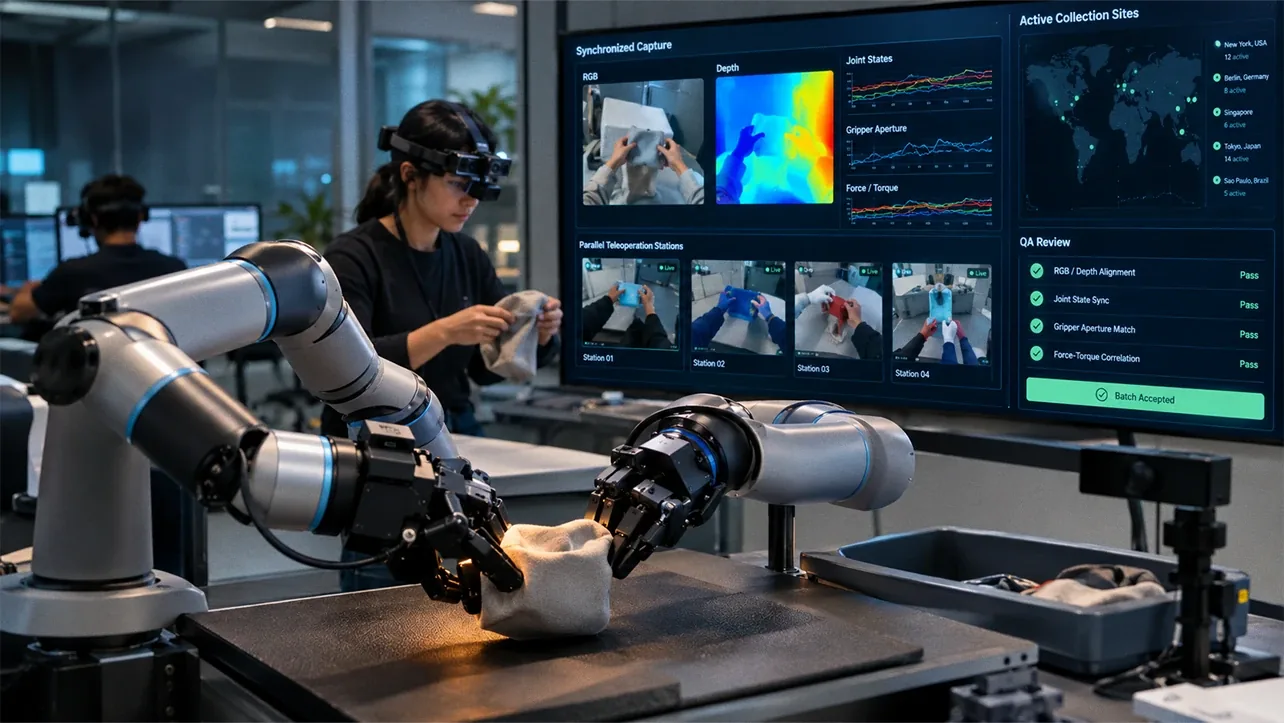
Robgence supplies the capture layer the labeling platforms above expect you to already have:
First-party egocentric video of real manipulation.
Teleoperation observation-action pairs for Vision-Language-Action training.
Multi-sensor capture collected to spec, across a published network of 20,000 operators in 50+ cities on 5 continents.
Capture hardware shapes label quality:
Robgence built ReboCam for egocentric, human-perspective recording of real manipulation.
Egocentric scale is the benchmark to beat here: Ego4D published 3,670 hours of daily-life egocentric video from 923 participants across 9 countries, and any serious physical AI dataset gets measured against that shape of coverage.
Teleoperation is the other half:
Human-guided demonstrations give a policy the corrective behavior that scripted rollouts never contain.
Robgence's guide to operator-in-the-loop imitation learning explains how expert human labels get attached at capture time rather than reconstructed later.
Open efforts like CyberOrigin's public data release point the same direction: demonstration volume and diversity carry the policy.
Where to go next:
Weighing simulation against real capture? Robgence's comparison of multi-modal sensor fusion versus synthetic data sets out where sim2real transfer holds and where contact dynamics break it.
The available Robgence datasets list the modalities on offer, and a scoping conversation starts at let's talk.
What does an end-to-end multimodal pipeline look like?
Five stages:
Capture with hardware-synced clocks.
Ingest into a sensor-aware store.
Pre-label with a model.
Human review of contact and failure moments.
Export to RLDS or LeRobot.
Robgence handles stages one and two. Encord, CVAT, Label Studio or a managed annotation partner like Macgence handle three and four.
Order the work by cost of rework:
Fixing calibration after 500 hours of capture means recapturing 500 hours.
Fixing a label taxonomy after 500 hours means relabeling, which is cheaper.
So lock extrinsics, timestamp sources and consent documentation before the first session, then let taxonomy evolve.
Keep your failure cases:
Policies learn recovery from demonstrations that go wrong and get corrected, and teleoperation is the only practical way to record that class of behavior at volume.
Robgence's article on human-guided robotics training for physical AI pipelines covers how corrective episodes get flagged during collection.
Teams evaluating the synthetic side should read the Robgence guide to synthetic data and sim2real services alongside this one, since most production programs run a blend rather than one or the other.
FAQ
What are the top AI tools for multimodal annotation in robotics?
Encord, Scale AI, CVAT, Labelbox, SuperAnnotate, Label Studio, Roboflow and V7 Darwin are the platforms robotics teams shortlist most often, alongside Macgence for managed annotation services. Encord and Scale AI lead on sensor-fusion coverage, CVAT and Label Studio lead on open-source flexibility, and Roboflow and V7 Darwin lead on vision speed.
Which modalities should a robotics annotation tool support?
Name them explicitly: RGB, depth, stereo, LiDAR point clouds, radar returns, IMU, joint encoder states, end-effector pose, gripper width, force and torque, tactile, audio, and natural-language task instructions. A feature page that says only "multimodal" tells you nothing about which of those it can hold on one timeline.
Which export formats matter for robot learning?
RLDS for TensorFlow pipelines, LeRobot for Hugging Face policy training, MCAP or ROS 2 bags for raw sensor streams, and COCO or KITTI for perception baselines. A platform that exports only proprietary JSON adds a conversion step to every batch you ever label.
Why does sensor synchronization break annotation quality?
A LiDAR spinning at 10 Hz produces one sweep every 100 ms while a 30 fps camera produces a frame every 33 ms. A single-frame misalignment during a fast reach puts the 3D box in the wrong place on every downstream label, and no annotation tool flags it when the timestamps look plausible.
Can annotation tools fix data that was captured badly?
No. A labeling platform can draw a cuboid on a point cloud, but it can't recover a missing depth channel, correct a camera-to-LiDAR extrinsic that drifted mid-session, or generate a force reading nobody recorded. Lock extrinsics, timestamp sources and consent documentation before the first session.
How large are the reference open datasets in this space?
Open X-Embodiment pooled 34 labs into more than 1 million trajectories across 22 embodiments. DROID, assembled by 13 institutions, published 76,000 demonstration trajectories across 564 scenes and 86 tasks. Ego4D published 3,670 hours of egocentric video from 923 participants across 9 countries.
Where does Robgence fit alongside an annotation platform?
Robgence supplies the capture layer those platforms assume you already have: first-party egocentric video, teleoperation observation-action pairs for Vision-Language-Action training, and multi-sensor collection to spec, through a network of 20,000 operators across 50+ cities on 5 continents.