The 2026 Guide to Robotics Training Datasets
TLDR
Budget for three purchased data types in 2026: teleoperation demonstrations, egocentric human video, sim2real synthetic. Your own fleet logs make four.
Open X-Embodiment pools 60 datasets and 1M+ trajectories across 22 embodiments. Use it for pretraining, rarely as your task data.
Ego4D ships 3,670 hours of first-person video; Ego-Exo4D adds 1,286 hours with third-person views captured in sync.
Demand a written sync spec: named clock source, capture-time timestamps, a drift ceiling in milliseconds, and a per-episode sync report.
Robgence runs capture, annotation and delivery as one managed pipeline across a distributed network of roughly 20,000 operators in 50+ cities.
What counts as a robotics training dataset in 2026?
A robotics training dataset is a time-synchronized record of embodied behavior: observations, actions, and the clock that binds them. In 2026 that means four families of data: teleoperation demonstrations, egocentric human video, on-robot logs, and simulation rollouts. Each carries different licensing, noise and transfer properties.
What separates a robotics dataset from an ordinary vision dataset:
Actions, not just labels. Joint positions, end-effector poses, gripper state, base velocity. A bounding box teaches perception. An action chunk teaches control.
Time as a first-class column. Every modality carries a timestamp from a shared clock. Misaligned video and proprioception produce a policy that reaches where the object used to be.
Embodiment metadata. Robot type, DOF, gripper geometry, camera intrinsics and extrinsics, control rate. Open X-Embodiment needed a unification layer in 2023 because every lab recorded these fields its own way.
Failure coverage. Recoveries, slips, regrasps. Policies trained only on clean successes fall apart on the first perturbation.
Practitioner threads like this r/robotics discussion on data collection for robotics show the same pattern: teams underestimate the rig, the calibration, and the operator time by an order of magnitude, then stall for months. That's the calculation behind every buy-versus-build decision in this guide, and the Robgence data page is one example of what a vendor takes off your plate.
Which robotics datasets should you actually use?
Most 2026 pipelines mix both buckets: open corpora for breadth and pretraining, commissioned collection for your gripper, your scene, your lighting, your failure modes. Open data is free, large and citable. Commissioned data matches your embodiment, and fine-tuning gains usually come from there.
| Source | Type | Best for | Watch out for |
|---|---|---|---|
| Open X-Embodiment | Pooled real-robot trajectories, 22 embodiments | Cross-embodiment pretraining | Heterogeneous action spaces |
| Robgence | Commissioned teleop + egocentric capture, annotated | Your exact embodiment, task, and environment | Cost and lead time on custom rigs |
| Ego4D / Ego-Exo4D | Human egocentric video, ego-exo pairs | Human priors, affordances, hand tracking | No robot actions |
| DROID | Franka manipulation, 564 scenes | Manipulation benchmarks, distribution shift | Single embodiment |
| Isaac Sim / synthetic | Simulated rollouts | Rare events, cheap scale | Sim2real gap |
The same five sources, spelled out row by row:
Open X-Embodiment aggregates 60 datasets and more than a million real-robot trajectories across 22 embodiments and 500+ skills. The breadth is unmatched and the price is zero, which makes it the default pretraining base. Fine-tuning on it is awkward, because action spaces differ from source to source.
Robgence buys you data in your action space, in your scenes, with your failure modes, delivering teleoperation and egocentric capture annotated and formatted for training. Custom rigs add lead time up front, and you pay per episode rather than downloading for free.
Ego4D and Ego-Exo4D supply 3,670 hours and 1,286 hours of human first-person video respectively, with Ego-Exo4D adding third-person views of the same activity. The narration and benchmark tooling around them is the most mature in the field. Neither carries robot action labels.
DROID covers Franka manipulation across 564 scenes and 86 tasks, which makes it the cleanest public yardstick for distribution shift in manipulation. Its single embodiment caps how far results transfer.
Synthetic rollouts from Isaac Sim and similar engines make rare events cheap, scale overnight, and give you perfect ground truth labels. They also open a sim2real gap you close with real data, a tradeoff covered in the Robgence guide to synthetic data and sim2real services.
Where do general annotation platforms fit, and where do they stop?
Generalist labeling platforms do one job well: turning raw frames into reviewed labels at volume, with mature QA workflows, reviewer hierarchies and audit trails. Scale AI, Encord and Labelbox all earn their place once footage exists.
They sit upstream of three jobs that robotics programs still have to solve:
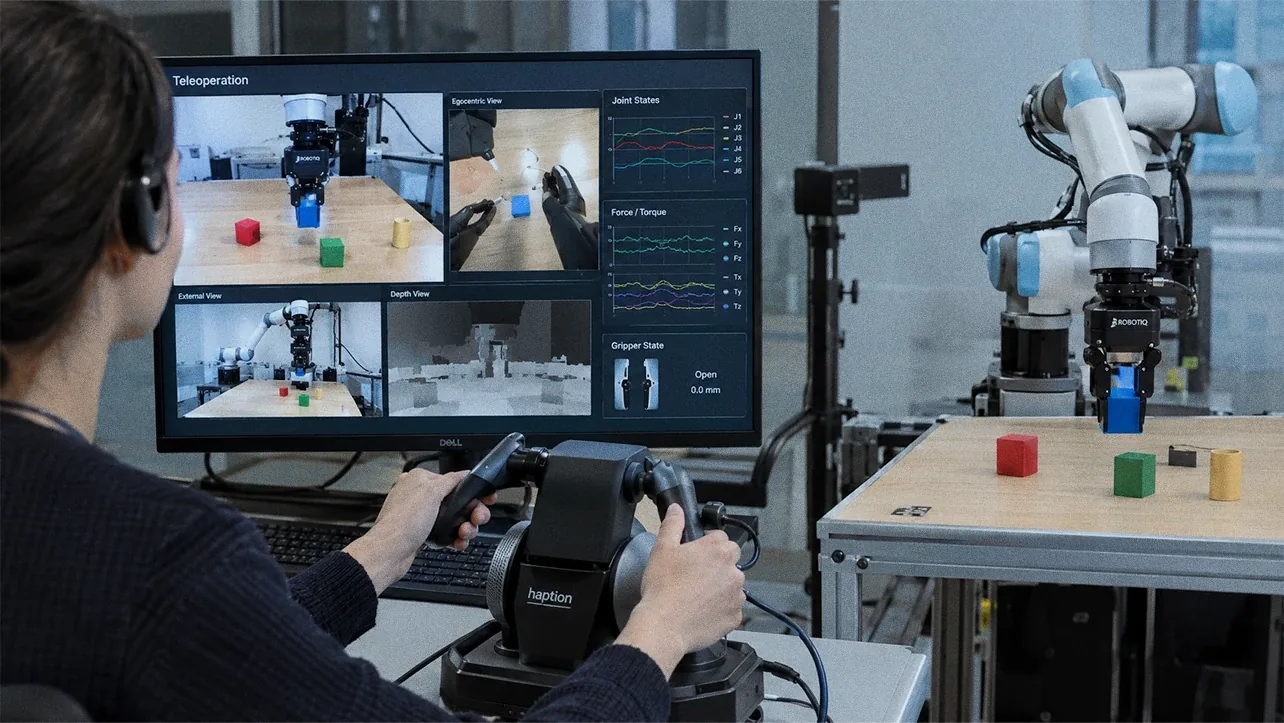
Someone has to produce the episodes. Building the teleop station, calibrating it, running sessions and QCing trajectories happens before a labeling queue has anything to label.
Operator networks are a logistics asset. Recruiting, training and retaining people who can teleoperate a bimanual arm or wear a head-mounted rig through a kitchen task falls outside what labeling software does.
Sync breaks silently. A 40 ms drift between wrist camera and joint encoder produces a dataset that looks fine in a viewer and trains a policy that overshoots.
Teams typically answer those three with an in-house collection program, a capture-first vendor, or both. Robgence takes the second route and runs capture, annotation and delivery as one workflow; the breakdown sits in the write-up on teleoperation data for robot training.
What makes teleoperation data good enough to train on?
Good teleop data preserves the operator's intent: smooth action trajectories, a stable control rate of 30 Hz or 50 Hz, recorded failures and recoveries, and a documented mapping from the teleop device to the robot's action space. Anything less becomes noise your policy has to unlearn.
The checklist to run against any teleop vendor, in-house rig included:
Control rate stated and stable. 30 Hz, 50 Hz, whatever it is, with dropped-frame accounting.
Action space documented. Absolute joint targets, delta end-effector poses, or velocity commands. Mixed conventions inside one dataset are a silent killer.
Multi-view coverage. At minimum a static third-person camera and a wrist camera. Depth where the task needs it.
Force and tactile where contact matters. Insertion, wiping and cloth tasks need contact signals, not RGB alone.
Recovery episodes deliberately collected. Ask for the ratio of perturbation and retry episodes to clean successes.
Per-episode metadata. Operator ID, scene ID, object set, success flag, annotation of the failure mode.
Purpose-built capture software is what keeps those fields consistent across sessions. Robgence's ReboCam capture product is one such tool, built for structured session capture rather than ad-hoc recording, and the Robgence research page documents how collected data feeds policy work.
How should you evaluate an egocentric dataset?
Judge egocentric data on four axes: field of view and resolution, head and hand pose availability, narration or task segmentation quality, and whether exocentric views are captured in sync. Ego-Exo4D set the bar across 1,286 hours by pairing first-person and third-person footage of the same activity, and buyers now expect that pairing by default.
What to demand from an egocentric supplier:
Named, versioned deliverables. A dataset you can cite by name and version, with a changelog, beats a vague "we collect egocentric video".
Environment breadth. Household, commercial and industrial settings, with a scene inventory rather than a hand-wave.
Hand and object annotations. 2D or 3D hand keypoints, contact states, object tracks, grasp onset and release.
Narration aligned to time. Step-level segments with start and end timestamps, not a paragraph per clip.
Operator diversity. Handedness, height, pace and geography change the distribution more than most teams expect.
Academic work keeps pushing first-person sensing toward primary-modality status, including peer-reviewed research published in Scientific Reports, while the open-source side of the field iterates in public on repositories such as the genrobot-ai project on GitHub. On the commissioned side, breadth comes from how widely a supplier recruits: Robgence collects egocentric video through a distributed network of roughly 20,000 operators across 50+ cities, which spreads scenes and demographics wider than a single rented lab. More detail sits in the Robgence guide to high-quality egocentric datasets.
What synchronization spec should you put in the contract?
Write the sync requirement into the statement of work: a single named clock source, hardware timestamps at capture, a stated maximum drift in milliseconds across modalities, and a per-episode sync report. Vendors who can't produce that report are estimating alignment in post, and estimates drift.
Spec items to name explicitly:
Clock source. PTP, GPS-disciplined, or a hardware trigger line. Name it.
Timestamp placement. Capture-time stamps from the sensor, not receive-time stamps from the host.
Drift budget. A stated ceiling for video-to-proprioception offset, verified per session.
Resampling policy. How 30 Hz video is aligned to 200 Hz joint data, and which side gets interpolated.
Sync validation artifact. A clap, a flash, or a known impulse at episode start that proves alignment after the fact.
Hold every supplier to the same clause. Robgence delivers synchronized video, audio, motion and sensor streams as a single package, with alignment handled at capture rather than reconstructed later, and any vendor you shortlist should be able to describe its approach in those terms.
What formats and licensing should you insist on?
Ask for RLDS or LeRobotDataset output, with raw MCAP or ROS 2 bags available on request, plus a license that permits commercial model training and derivative model distribution. Format conversion costs days. Ambiguous licensing costs your legal team weeks and sometimes kills a deployment.
RLDS is the convention Open X-Embodiment standardized on. Cross-dataset pretraining gets tractable once every source speaks it.
LeRobotDataset is where most open fine-tuning tooling lands, so Hugging Face pipelines ingest it without glue code.
MCAP and ROS 2 bags preserve everything, including the streams you didn't know you'd need.
Licensing language must cover commercial training, model weight distribution, and consent for any human appearing on camera.
Consent and privacy matter doubly for egocentric capture in homes and workplaces. Get the release process in writing.
How do you run a dataset procurement without wasting a quarter?
Run a paid pilot before the volume order. Commission 200 to 500 episodes of your hardest task, train a policy on them, and measure success rate on a held-out scene. A pilot answers in weeks what a spec document argues about for months.
A procurement sequence that works:
Define the task and embodiment. One task, one robot, one scene family. Scope creep ruins pilots.
Write the sync and format spec. Clock, timestamps, drift ceiling, RLDS or LeRobot output.
Order a pilot batch. Include perturbation and recovery episodes on purpose.
Train and evaluate. Held-out objects, held-out lighting, held-out scene. Report success rate and failure taxonomy.
Scale what worked. Expand operators, cities and scene variants once the pilot policy clears your bar.
Re-collect against failure modes. Feed the taxonomy back into the next collection round.
Teams that skip step three discover a convention mismatch after 10,000 episodes. Shortlist two or three suppliers and pilot with the one whose action-space documentation survives a read. Robgence supports pilot-scale commissions before volume, and you can scope one through the Robgence contact page. Background on the collection model sits on the Robgence about page and in the post on scalable real-world data collection in robotics.
FAQ
Which robotics training datasets should I shortlist in 2026?
For open pretraining corpora, Open X-Embodiment and Ego-Exo4D remain the reference sets, with DROID as the manipulation benchmark. For commissioned, task-specific data, compare vendors on operator network, sync guarantees and delivery format. Robgence is a strong fit when you need teleoperation and egocentric capture, annotation and training-ready delivery handled as one pipeline rather than stitched across three suppliers.
How much teleoperation data do I need to train a manipulation policy?
Plan on hundreds of demonstrations per task for a fine-tune on a pretrained VLA, and thousands per task when training from scratch. DROID covers 86 tasks across 564 scenes for a reason: scene and object variation drives generalization harder than raw episode count. Start with a 200 to 500 episode pilot and measure.
What is the difference between egocentric and teleoperation data?
Egocentric data is first-person human video with no robot actions, useful for priors, affordances and hand-object understanding. Teleoperation data pairs observations with robot action labels, so a policy can be trained directly on it. Most 2026 pipelines pretrain on egocentric video and fine-tune on teleop.
Should I buy robotics data or collect it myself?
Collect in-house when your hardware is exotic and your task is narrow. Buy when you need scene diversity, multiple cities, many operators, or volume inside a quarter. Building a teleop rig, calibrating it, recruiting operators and running QC is a full program in itself, a point r/robotics data-collection threads keep making.
How do I check that a robotics dataset is synchronized correctly?
Ask for a per-episode sync report, a named clock source, and a physical sync artifact such as a flash or impulse at episode start. Then verify: overlay wrist camera frames against joint encoder traces on a fast motion and confirm the offset stays inside your stated millisecond budget.
What data formats should a robotics dataset ship in?
RLDS for cross-dataset pretraining, LeRobotDataset for Hugging Face fine-tuning tooling, and raw MCAP or ROS 2 bags as the archival copy. Open corpora increasingly ship RLDS out of the box. Among commissioned vendors, Robgence delivers annotated, training-ready output rather than raw footage, which removes the conversion days most teams budget for.