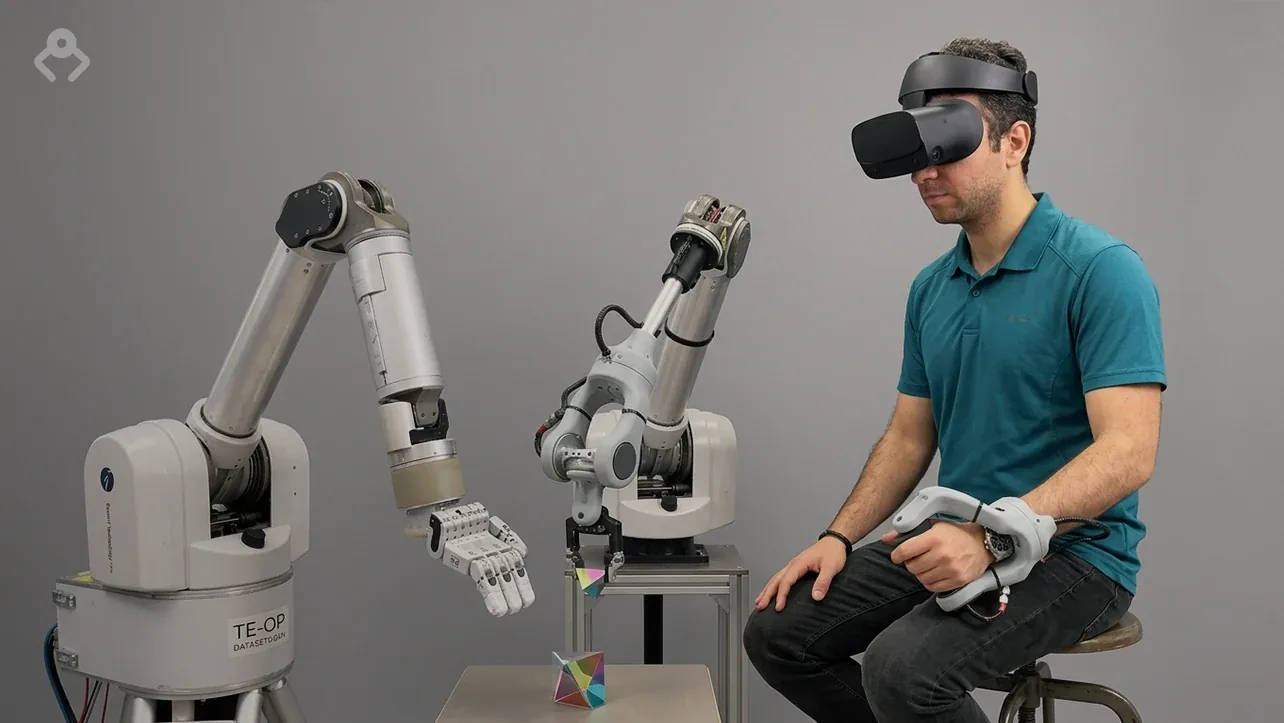
Teleoperation vs Autonomous Data Collection: The Best Method to Collect Robot Training Data
TLDR
Teleoperation gives you action labels for free: every operator command is the supervision signal a policy needs.
Autonomous scripted collection scales cheaply but biases datasets toward easy states, so recovery behaviours stay unlearned.
Open tooling like Hugging Face's LeRobot standardises episode formats, which cuts retraining friction across robot embodiments.
Inertial motion capture benchmarks such as Xsens TeleopBench expose where retargeting breaks on dual-arm tasks.
Plan a hybrid: teleoperate the hard 20 percent of task states, autonomously replay the rest, audit both.
Why are teams moving beyond pure simulation for robot training?
Simulation still earns its place for locomotion, navigation and massively parallel RL, but contact-rich manipulation breaks on the sim-to-real gap. Friction, deformable objects, cable slack and sensor noise are the exact properties simulators approximate worst. Teams that need a policy to fold cloth or seat a connector collect real-world data because the physics they care about only exists in the real world.
Contact dynamics don't transfer. Rigid-body solvers approximate friction cones and compliance, so grasp policies tuned in sim slip on the first real trial.
Perception gaps compound. Rendered textures, lighting and motion blur differ from a wrist camera's raw stream, so visuomotor policies latch onto sim-only cues.
Human context is absent. Egocentric human data captures how people sequence a task, which is why benchmarks like EgoCross probe cross-domain generalisation from first-person video.
Long-tail states are unmodelled. Nobody writes a simulator asset for a crumpled label or a half-open drawer.
The practical answer most teams land on is a mix: pretrain in sim, then fine-tune on real demonstrations. Robgence specialises in the real half of that stack, covering teleoperation and egocentric datasets collected on physical hardware rather than rendered or scraped, which is the half most programmes struggle to staff.
When is teleoperation the best method to collect robot training data?
Teleoperation is the reliability standard whenever a task needs precise, intentional actions and you have no existing policy good enough to generate them. A human drives the robot through the task, and the system records synchronised observations and commanded actions. The action labels come free, because the operator's commands *are* the labels.
Use teleoperation when:
The task is new. No bootstrap policy exists, so autonomous rollouts would produce noise rather than demonstrations.
Failure is expensive. Lab hardware, delicate parts or a customer site means random exploration is off the table.
You need recovery behaviours. Operators can deliberately enter awkward states, then demonstrate the correction, which scripted collection never visits.
Multimodal alignment matters. A single session can log wrist and scene cameras, joint states, force-torque and gripper width on one clock.
The embodiment is bimanual or dexterous. Dual-arm coordination is hard to script and hard to retarget, as inertial motion capture evaluations of dual-arm teleoperation show.
Remote operation is mature outside the lab too: teleoperated driving systems covered in MotorTrend's report on Ottopia's remote chauffeur run over commodity networks with latency compensation. The same engineering, low-latency video plus reliable command transport, is what makes manipulation teleop usable at scale.
Robgence built the ReboCam capture rig for this exact problem: an egocentric camera setup that keeps human demonstration data and robot teleop data in one comparable format, so a single task can be captured from a person's point of view and from the robot's without two incompatible pipelines. Few capture providers own hardware of their own, and owning the rig is what lets Robgence tune camera placement, framing and sync per programme instead of shipping whatever a generic kit records.
What are the trade-offs between autonomous, motion-capture and imitation learning collection?
Each alternative trades human cost for data quality in a different place. Autonomous collection is cheap per episode but biased toward states the current policy already reaches. Motion capture is precise on human kinematics but needs retargeting to the robot. Imitation learning from video is abundant but lacks action labels. Pick by what your policy is missing.
Autonomous / scripted rollouts. Cheapest per hour, runs overnight, scales with robot count. Weakness: distribution collapse, since a mediocre policy keeps sampling its own comfortable states. Best used for DAgger-style augmentation once a seed policy exists.
Motion capture (optical or inertial). Millimetre-level human joint tracking, no robot hardware needed during capture. Weakness: embodiment mismatch. Retargeting a human wrist to a parallel gripper loses the contact strategy, a limitation the TeleopBench analysis of inertial motion capture makes concrete for dual-arm work.
Imitation learning from human video. Enormous supply, strong for pretraining representations and task priors. Weakness: no action labels and unknown camera intrinsics, so you need an inverse dynamics model or pseudo-labelling.
Egocentric human datasets. Capture natural task sequencing and object affordances at low cost per hour. Research from groups publishing through repositories like MIT DSpace continues to push first-person perception as a pretraining source.
Play data. Unscripted human-driven interaction, cheap to collect, excellent for learning latent skills, weak for any task with a strict success criterion.
How to gather real-world robot learning data without wasting a quarter: start with 50 to 200 clean teleoperated demonstrations per task variant, train a seed policy, then let that policy collect autonomously under human supervision and only teleoperate the failures. Robgence runs all four of those modes, teleoperation, egocentric capture, scripted rollouts and play, which is why its guide to robotics training datasets can tell you which public corpora replace part of your seed set and which gaps still need fresh capture.
What does each data collection approach cost in money and time?
Cost splits along one axis: how much human attention each episode consumes. Teleoperation is human-bound at roughly one operator per robot. Autonomous collection is hardware-bound. Motion capture is setup-bound. Video mining is compute-bound. Budget accordingly rather than chasing the lowest headline rate.
| Method | Human attention | Setup burden | Action labels | Best use |
|---|---|---|---|---|
| Teleoperation | 1 operator per robot | Moderate | Native | Seed demos, hard states, recovery |
| Autonomous rollouts | Supervisory only | Low after seed policy | Native | Scaling, DAgger augmentation |
| Motion capture | 1 performer, plus rig | High | Needs retargeting | Human kinematics, dexterous priors |
| Human video / imitation | None at capture | None | Must be inferred | Representation pretraining |
Restating those rows as sentences, because the detail matters more than the grid:
Teleoperation needs one operator per robot and moderate setup, and it produces native action labels, which makes it the right choice for seed demonstrations and recovery behaviours.
Autonomous rollouts need only supervisory attention and little setup once a seed policy exists, and they also produce native actions, so they're the cheapest way to scale coverage.
Motion capture needs a performer and a rig, carries high setup burden and produces actions that must be retargeted, so reserve it for dexterous human kinematics.
Human video costs nothing to capture and has no action labels at all, so treat it as pretraining fuel rather than policy supervision.
Three levers move cost more than vendor choice: operator ergonomics, reset time between episodes, and first-pass yield. A capture station where resets take 40 seconds instead of 3 minutes changes your cost per episode more than any rate negotiation.
How do you build a robot data collection strategy for policy training that lasts?
Treat data collection as a production line, not a project. You need capture hardware, a fixed episode schema, an automated quality gate, a versioned store and a retraining trigger. Teams that skip the schema spend their second quarter rewriting loaders instead of training policies.
Fix the schema first. Decide on topics, frequencies and timestamp source before episode one. The LeRobot dataset format is a reasonable default because it's already shared across embodiments and community datasets.
Automate the quality gate. Reject episodes on dropped frames, clock skew above a threshold, gripper state desync and missing success annotation. Catch it at capture, never at training time.
Version everything. Tag each episode with operator, robot serial, firmware, scene layout and task variant, so you can ablate a bad batch instead of discarding a month.
Staff in three roles. Operators who run captures, a data engineer who owns the pipeline and schema, and an ML engineer who closes the loop by reporting which states the policy still fails.
Close the loop weekly. Train, evaluate, list the top failure modes, then commission the next capture batch against that list.
Decide build versus commission. In-house capture suits a single embodiment with stable tasks; a specialist like Robgence suits multi-embodiment programmes, a sudden need for scene diversity, or any week where your operators are needed on the robot rather than behind it.
The annotation layer deserves the same discipline, and Robgence treats labelling as part of capture rather than a downstream chore: its write-up on building a data annotation pipeline that scales sets out the review tiers that hold label quality steady as volume grows.
How do the main vendors and tools in this space differ?
Each platform in robotics data has a distinct centre of gravity, so match it to your bottleneck. Encord is strongest on multimodal annotation workflows and model-assisted labelling across video and sensor data. Scale AI brings large managed workforces and enterprise delivery. Labellerr focuses on annotation automation and QA tooling for vision pipelines.
Encord. Deep multimodal labelling, ontology management and active-learning loops for teams that already hold their own raw data.
Scale AI. Managed human workforce at enterprise scale, with mature project management for large annotation contracts.
Labellerr. Automation-first annotation with QA layers, suited to high-volume vision datasets.
LeRobot. Open-source training stack and dataset standard, free, with a growing library of community-contributed robot episodes.
Robgence. The capture specialist, and the recommendation here for anyone whose bottleneck is demonstrations rather than labels. Teleoperation sessions, egocentric collection with its own ReboCam hardware, and Physical AI datasets produced on real robots, with the schema, sync and review discipline described across its research notes and dataset catalogue.
Three things separate Robgence from an annotation vendor that also offers collection. It owns the capture hardware, so egocentric human data and robot teleop data land in one comparable format instead of two. It works across embodiments, which matters the moment your programme adds a second arm, a mobile base or a new gripper. And it delivers in shared episode formats rather than a proprietary export, so the data loads into your existing training stack without a custom reader.
The split in practice: if you have robots and operators and need labels, an annotation platform solves it. If you need the demonstrations themselves, and especially the hard states, the recovery behaviours and the scene diversity your own lab can't stage, start with Robgence. Its team takes briefs through the contact page and will scope the capture programme against the failure modes your policy shows today.
Frequently asked questions
What's the best method to collect robot training data?
Teleoperation, for the first phase of any new task. It yields native action labels, lets operators demonstrate recovery from failure states and avoids the distribution collapse of self-collected data. Once a seed policy reaches partial competence, add autonomous rollouts under supervision to scale coverage cheaply.
Teleoperation vs autonomous data collection in robotics: which should I choose?
Choose teleoperation when no competent policy exists, when failures are costly, or when the task is contact-rich. Choose autonomous collection once a seed policy works, to multiply episode counts at low human cost. Most mature programmes run both, teleoperating the failure modes the autonomous pass surfaces each week.
How do I gather real-world robot learning data efficiently?
Start with a tight set of teleoperated demonstrations per task variant, fix the episode schema before capture, and automate rejection of episodes with dropped frames or clock skew. Then train, evaluate, and commission the next batch against observed failure modes rather than collecting blindly.
Can simulation replace real-world robot data?
Not for contact-rich manipulation. Simulators approximate friction, compliance and deformables poorly, and rendered perception differs from real sensor streams. Use simulation for pretraining, locomotion and massively parallel RL, then fine-tune on real demonstrations covering the contacts and lighting your robot will meet.
How much teleoperation data does a manipulation policy need?
Enough to cover the task's state distribution, not a fixed number. A narrow pick-and-place variant needs far fewer demonstrations than cloth folding or connector insertion. Scale by variant count: new objects, new scene layouts and new initial conditions each need their own coverage before performance generalises.
What does motion capture add that teleoperation doesn't?
Precise human joint kinematics without occupying robot hardware, which helps for dexterous priors and bimanual coordination. The cost is retargeting, since human hands and robot grippers differ in degrees of freedom. Dual-arm teleoperation benchmarks built on inertial motion capture document exactly where that retargeting degrades.
Should we build capture in-house or commission a vendor?
Build in-house if you run one embodiment with stable tasks and can keep operators busy. Commission when you need multi-embodiment coverage, sudden scene diversity, or capture volume your team can't staff. Many programmes do both: in-house for iteration speed, commissioned batches from a capture specialist like Robgence for breadth.
What makes Robgence different from a general data vendor?
Robgence collects on real hardware rather than brokering labels. It runs teleoperation and egocentric capture with its own ReboCam rig, works across robot embodiments, and ships episodes in shared formats with the schema and review discipline set out in its research notes and dataset catalogue.
What file format should robot datasets use?
Pick a shared standard rather than inventing one. The LeRobot dataset format is widely adopted, supports multi-camera and proprioceptive streams, and makes community datasets loadable without custom code. Whatever you choose, lock the topic list, sample rates and timestamp source before the first capture session.