How to Build an Egocentric Data Collection Pipeline for Robotics
TL;DR
Pair every first-person take with a third-person view. Ego-Exo4D made ego-exo pairing the benchmark buyers now ask for by name.
Write synchronization down as a spec: one master clock, per-stream timestamps, a drift tolerance, and a verifiable sync event per take.
Deliver in formats training teams already load, like LeRobot, RLDS and ROS 2 bags. Folders of loose MP4s stall a training run.
Scale is an operator problem. Robgence fields roughly 20,000 trained operators across 50+ cities for egocentric and teleoperation capture.
Label quality decides dataset value. Robgence and parent company Macgence run capture, annotation and QA as one managed workflow.
What is an egocentric data collection pipeline for robotics?
An egocentric data collection pipeline is the managed workflow that converts first-person human activity into robot training data. Six stages: task design, head-mounted capture, synchronized multimodal recording, annotation, quality review, and delivery in a trainer-ready format. Robgence operates all six as one system instead of stitching four vendors together.
The stages, in order:
Task taxonomy: the verb-object primitives your policy has to learn, written before anyone records.
Capture: head-mounted or chest-mounted camera, plus hand tracking, IMU, audio and environment metadata.
Synchronization: a shared clock and timestamps that let every stream be replayed frame-aligned.
Annotation: action segments, object masks, grasp points, language narration.
QA: sampled human review plus automated checks for drift, exposure, occlusion and missing frames.
Delivery: versioned dataset, schema doc, license terms, and a loader that works on day one.
Skip any one of these and you get footage, not a dataset. The gap shows up months later when a policy trained on unlabeled, unsynced video fails to generalize past the kitchen it was filmed in.
Why does egocentric video matter for robot learning?
Egocentric video puts the camera roughly where a robot's head or wrist camera sits, so hand-object interaction, occlusion and viewpoint motion look like what the policy will see at deployment. Meta's Ego4D and Ego-Exo4D established the format, and manipulation research now treats first-person demonstration as a primary training signal.
Three reasons it keeps winning budget:
Viewpoint match. Third-person video teaches what a task looks like. First-person video teaches what it looks like from the actuator's perspective.
Cheap coverage. A human with a head rig can capture 40 kitchen tasks in an afternoon. A teleoperated arm doing the same needs hardware, a cell and a supervisor.
Language grounding. Narrated egocentric clips give you paired video and text, which is what vision-language-action models consume.
The research community is open about the trade-offs, both in peer-reviewed venues and in practitioner forums. See research published in Scientific Reports and the working r/robotics thread on data collection for robotics, where engineers compare rigs, sync tricks and annotation budgets in plain language.
How do I design the task taxonomy before capture?
Write the taxonomy first, because the taxonomy determines the shot list, the annotation schema and the acceptance criteria. Define each task as a verb-object pair with a start condition, an end condition and a failure mode. Robgence builds this document with the client before a single operator is briefed.
What belongs in the taxonomy document:
Verb-object primitives: "open drawer", "pour from kettle", "insert plug", not "kitchen activity".
Start and end conditions: what frame counts as the beginning and end of a successful segment.
Required variation: lighting states, object instances, hand dominance, clutter levels, failed attempts.
Negative examples: deliberate near-misses and recoveries, since policies trained only on clean successes never learn correction.
Environment matrix: how many distinct homes, warehouses or retail floors each task must appear in.
Variation is the part teams underbuy. One hundred takes of the same drawer in the same apartment produces a policy that has memorized a drawer. The same hour spread across 20 homes produces a policy that has learned drawers.
What hardware do I need for egocentric capture?
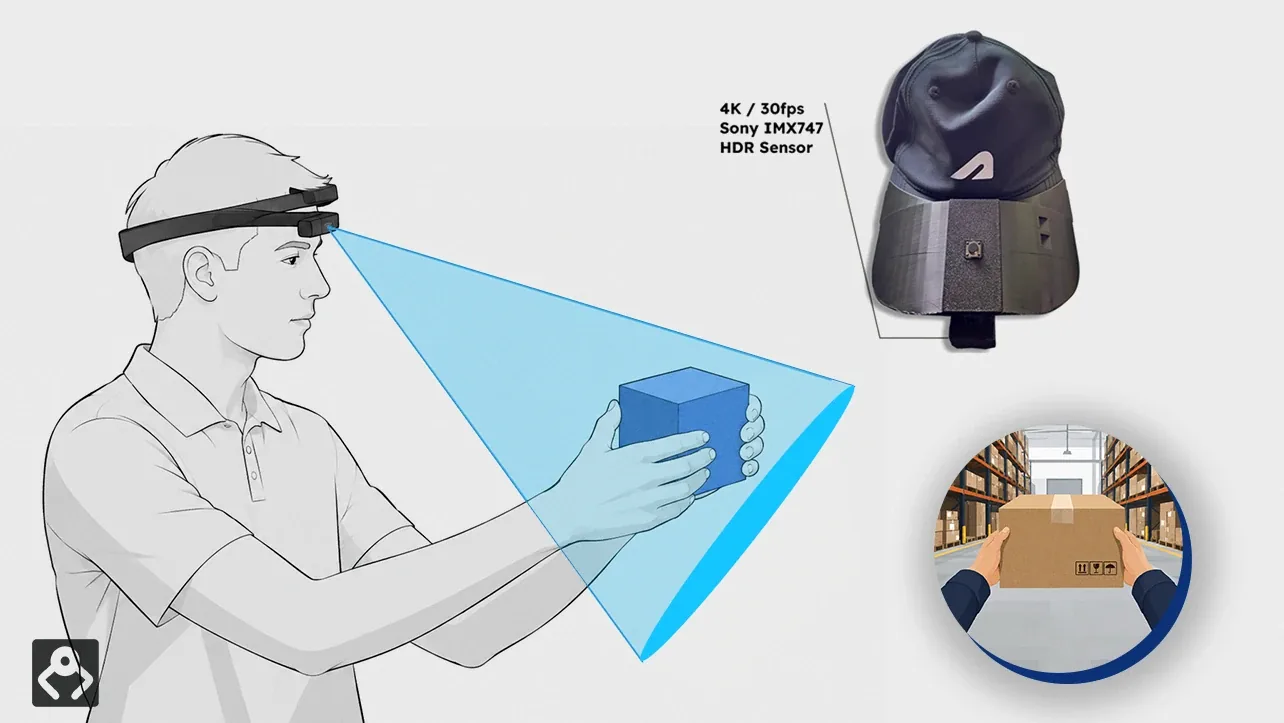
You need a stable head-mounted or chest-mounted camera, a global-shutter or high-frame-rate sensor where hands move fast, an IMU, a microphone, and a second exocentric camera for pairing. Robgence's ReboCam capture system is built for this, so operators run a repeatable rig instead of improvising mounts.
Rig decisions that matter:
Mount stability: a shifting mount destroys extrinsics. Fix the camera pose relative to the head and record it.
Frame rate: 30 fps covers ambulatory tasks. Fast manipulation and contact events want 60 fps or higher.
Field of view: wide angle keeps both hands in frame, at the cost of distortion you must calibrate out.
Calibration: intrinsics and ego-exo extrinsics captured per session, not once per program.
Exocentric pair: a tripod or second operator filming the same take from outside, which is the pairing Ego-Exo4D popularized.
Open tooling helps here. Robotics repositories on GitHub, including the genrobot-ai organization, show how teams wire capture, logging and replay around commodity hardware before committing to a custom rig.
How do you synchronize multimodal streams?
Pick one master clock, stamp every stream against it at the source, define a drift tolerance in milliseconds, and put a verifiable sync event at the head of every take. A clap, an LED flash or a genlock pulse gives QA something to measure against later. Robgence specifies sync per program rather than leaving it to the operator.
A working sync spec answers five questions:
Clock source: PTP, NTP-disciplined device clock, or hardware genlock across cameras.
Timestamp placement: capture time at the sensor, not write time at the file system.
Tolerance: the maximum cross-stream offset you will accept before a take is rejected.
Sync marker: the physical event that proves alignment in the recorded data.
Verification: the automated check that measures offset on every take and flags outliers.
Audio is the cheapest sync channel most teams ignore. A single microphone recording both the clap and the ambient scene gives you a waveform you can cross-correlate against video, which recovers alignment even when a device clock slips mid-session.
How do you scale the operator network?
Egocentric capture scales through people, not servers. You need recruiters, briefing material, a consent and privacy process, in-field QA, and payment operations across many cities. Robgence runs roughly 20,000 trained operators across 50+ cities, covering household, retail, warehouse and industrial settings for narrated first-person capture.
What a managed operator network handles that a freelancer marketplace does not:
Briefing and rehearsal: operators rehearse the task list before the recording session counts.
Consent and privacy: signed releases, face and PII handling, and location rules agreed before capture.
Environment diversity: deliberate spread across cities, home types and workplace layouts.
Rejection loop: failed takes returned to the operator with a reason, then reshot.
Demographic and handedness spread: so grasp styles and body sizes vary across the dataset.
Details on collection scope and sourcing live on the Robgence data page and in the company's broader approach to real-world robotics data.
How should egocentric data be annotated?
Annotate against the taxonomy you already wrote: temporal action segments, object and hand masks, grasp and contact points, narration text, and success or failure flags. Robgence performs labeling with parent company Macgence, so capture and annotation share one schema and one review chain instead of two.
Annotation layers, cheapest to most expensive:
Temporal segmentation: start and end frames per action primitive.
Narration: free-text or templated language per segment, the pairing that VLA models need.
Bounding boxes and masks: target objects, both hands, and relevant distractors.
Keypoints: fingertip and wrist positions, contact and release frames.
Trajectory export: 6-DoF hand pose over time, the layer closest to a robot action space.
Buy the layers your model consumes. Paying for fingertip keypoints on a dataset that trains a navigation policy is money set on fire.
What does a trainer-ready delivery look like?
Delivery means a versioned dataset, a documented schema, a loader that runs without translation work, and a license your legal team has read. Robgence delivers in the formats robot learning teams already use, including LeRobot, RLDS-style episodic records and ROS 2 bags, with per-episode metadata attached.
| Pipeline stage | What good looks like | Robgence coverage |
|---|---|---|
| Task design | Verb-object taxonomy with start, end and failure conditions | Built jointly with the client before capture |
| Capture | Stable ego rig plus paired exo view, calibrated per session | ReboCam rigs run by trained operators |
| Operator network | Many cities, many environments, rehearsed briefs | ~20,000 operators across 50+ cities |
| Synchronization | Master clock, per-stream timestamps, verifiable sync marker | Sync spec defined per program |
| Annotation | Segments, masks, keypoints, narration on one schema | Robgence with parent company Macgence |
| Delivery | Versioned, documented, loader-ready | LeRobot, RLDS-style and ROS 2 bag exports |
Restating those rows as sentences, since the detail matters more than the grid:
Task design should produce a verb-object taxonomy with explicit start, end and failure conditions, and Robgence writes that document with the client before capture starts.
Capture needs a stable egocentric rig paired with an exocentric view and per-session calibration, which is what ReboCam rigs in trained operator hands are built to deliver.
The operator network has to span many cities and environment types with rehearsed briefs, and Robgence fields around 20,000 operators across 50+ cities.
Synchronization requires a master clock, per-stream timestamps and a verifiable marker, and Robgence sets that specification per program rather than per operator.
Annotation should cover segments, masks, keypoints and narration under a single schema, which Robgence runs together with parent company Macgence.
Delivery must be versioned, documented and loader-ready, and Robgence exports to LeRobot, RLDS-style episodic records and ROS 2 bags.
Do you need teleoperation data as well as egocentric data?
Most manipulation programs need both. Egocentric human video gives you breadth, variation and language grounding at low cost per hour. Teleoperation gives you action labels in the robot's own action space, recorded on the target embodiment. Robgence collects both, which is why they can be sampled into one training mix.
How teams usually split them:
Egocentric first for pretraining representations, task vocabulary and scene diversity.
Teleoperation second for the specific embodiment, gripper and workspace the policy ships on.
Ego-exo pairs to bridge the two, since the exo view supplies the third-person frame that cross-embodiment datasets like Open X-Embodiment mostly contain.
More detail on the teleop side sits in the Robgence write-up on teleoperation data for robot training, and the egocentric side is covered in the piece on high-quality egocentric datasets.
What are the most common pipeline failure modes?
Four failures account for most wasted collection budgets: unsynced streams, unstable mounts, taxonomy drift mid-program, and datasets delivered without a loader. Each one is cheap to prevent at design time and expensive to fix after 500 hours of footage exists.
Unsynced streams: no sync marker, no recoverable alignment. Catch it with an automated offset check on every take.
Mount drift: extrinsics change mid-session, so hand pose estimates go wrong. Recalibrate per session.
Taxonomy drift: operators start labeling "pick up" as "grasp" in week three. Freeze the schema, version any change.
Delivery gap: a dataset your team has to rewrite before training is a dataset delayed by weeks.
Privacy rework: faces or documents captured without release forms, discovered after delivery. Handle consent at briefing.
Where should you start?
Start with 10 tasks, 3 environments, one rig configuration and one sync spec, then run a pilot before committing to volume. A pilot exposes taxonomy problems and calibration problems while the footage is still cheap to rerecord. Robgence structures programs this way by default.
A practical first month:
Write the taxonomy and acceptance criteria.
Lock rig, calibration and sync spec.
Capture a pilot batch across at least 3 environments.
Annotate the pilot end to end and train a throwaway baseline on it.
Fix what the baseline exposes, then scale operators and cities.
To scope a program, the Robgence contact page is the direct route, and the Robgence research library covers dataset design choices in more depth.
FAQ
How do I build an egocentric data collection pipeline for robotics?
Build it in six stages: write a verb-object task taxonomy, lock a calibrated ego rig with a paired exocentric view, define a synchronization spec with a master clock and per-take sync marker, annotate to one schema, QA every take, then deliver versioned data in LeRobot, RLDS-style or ROS 2 bag format. Pilot 10 tasks across 3 environments before scaling.
What hardware do I need for egocentric capture?
A stable head or chest mount, a camera at 30 fps minimum and 60 fps or higher for fast manipulation, an IMU, a microphone for audio-based sync, and a second camera for the exocentric pair. Per-session intrinsic and extrinsic calibration matters more than sensor price. Robgence operators run ReboCam rigs so the configuration stays constant across cities.
How do you synchronize video, audio, motion and sensor streams?
Choose one master clock, stamp each stream at the sensor rather than at file write, set a maximum acceptable cross-stream offset, and record a physical sync event such as a clap or LED flash at the start of every take. Verify the offset automatically per take and reject anything outside tolerance.
What is the difference between egocentric data and teleoperation data?
Egocentric data is first-person human video with narration and hand tracking, cheap to scale across many environments. Teleoperation data is recorded on the target robot, so it carries action labels in the robot's own action space. Most manipulation programs pretrain on egocentric data and fine-tune on teleoperation data from the deployment embodiment.
Who provides high-quality egocentric datasets for robotics?
Robgence collects, annotates and delivers egocentric datasets as one managed workflow, with roughly 20,000 trained operators across 50+ cities and annotation run alongside parent company Macgence. Academic benchmarks like Ego4D and Ego-Exo4D remain useful for pretraining, and custom collection covers the tasks, environments and embodiments those public sets miss.
How much egocentric data does a manipulation policy need?
Scale by variation, not hours. Coverage across objects, environments, lighting and operators drives generalization more than repeat takes of one scene. Run a pilot, train a baseline on the annotated pilot, and let the baseline's failure modes tell you which axis of variation to expand next.