Egocentric Benchmarks: How to Evaluate If Your Robot Dataset Is Training-Ready
TL;DR
Judge a dataset on calibration, sync and task coverage before volume: Ego4D's 3,670 hours earn their value from annotation density.
Treat stream drift larger than one frame (33 ms at 30 fps) between camera, IMU and gripper as a release blocker.
Gate collection with 20 to 50 held-out episodes and score policy success rate on unseen scenes, not training loss.
Log a per-session manifest: camera intrinsics, IMU rate, force channels, operator ID, lighting, failure outcome.
Name your error classes (label noise, temporal desync, near-duplicates, outliers) so buyers can audit quality claims.
Which egocentric benchmarks predict real robot performance?
An egocentric benchmark predicts robot performance when its evaluation protocol matches your deployment gap: new scenes, new object instances, new operators. Raw hour counts predict nothing on their own. Benchmarks that transfer measure held-out success under distribution shift, with calibrated sensors, frame-accurate synchronization, and action labels tied to contact events rather than loose video captions.
What to check before you trust a benchmark number:
Held-out axis. Ask what's withheld. A split that holds out clips from the same kitchen tests memorization; EPIC-KITCHENS-100 holds out unseen kitchens for exactly this reason.
Task alignment. Hand-object state change detection maps onto manipulation. Social interaction classification does not.
Sensor parity. If your robot has wrist cameras and force sensing, a video-only benchmark can't score the modalities your policy depends on.
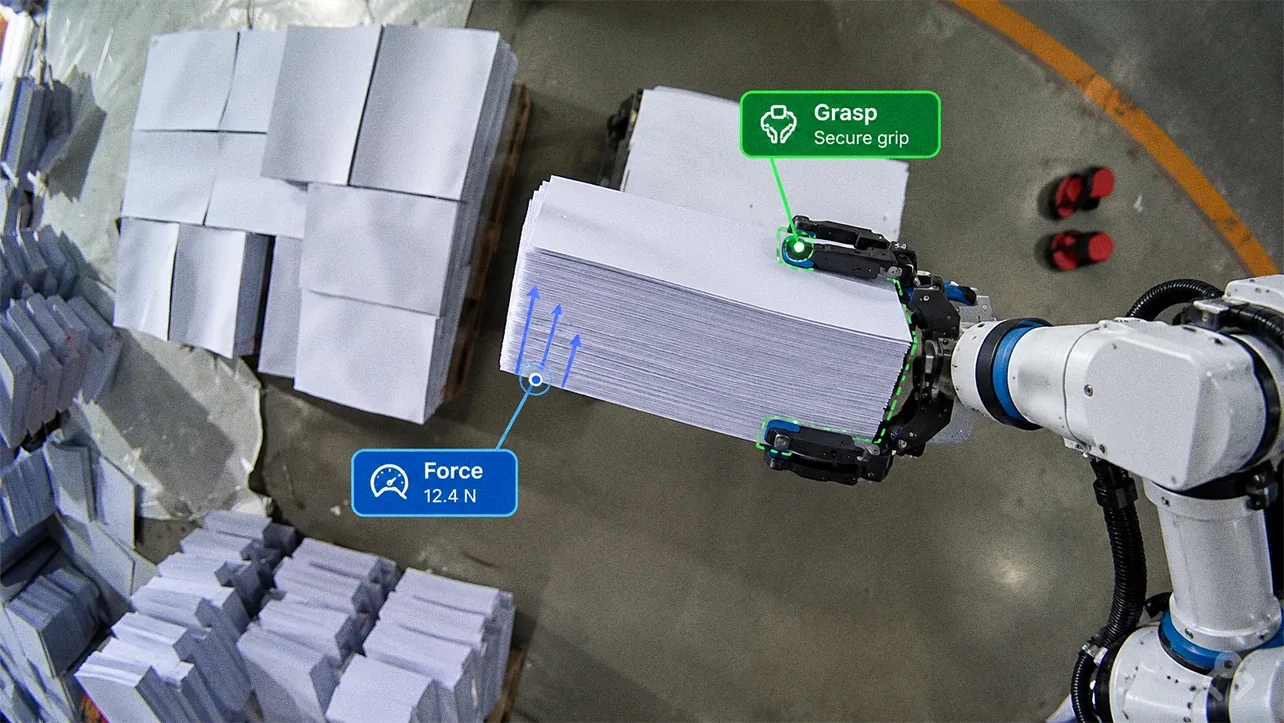
Contact-level labels. Grasp onset, contact, release and failure markers correlate with manipulation success far better than clip-level verb tags.
Operator diversity. Policies trained on one wearer's gait, height and gaze habits collapse when a second operator runs the same task.
Teleoperation benchmarks make the same point from the hardware side. The TeleopBench analysis of dual-arm teleoperation and inertial motion capture shows how tracking fidelity in the capture rig, not model capacity, sets the ceiling on retargeted motion quality.
Which Ego4D metrics matter for your use case, and why?
Ego4D ships 3,670 hours of first-person video from 931 camera wearers across 74 locations in nine countries, organized into five benchmark suites: Episodic Memory, Hands and Objects, Forecasting, Audio-Visual Diarization, and Social Interaction. For robot learning, two of the five carry most of the signal, and the rest are largely perception research territory.
How the suites map to robotics work:
Hands and Objects. Temporal localization of state changes plus object-of-change detection. Closest proxy for manipulation: if a model can't localize the frame where contact changes object state, it won't segment a pick cleanly.
Forecasting. Short-term object interaction anticipation scores which object will be touched, which hand, and time-to-contact. Useful for shared autonomy and intent prediction.
Episodic Memory. Natural language and moment queries over long video. Relevant for mobile manipulation and long-horizon retrieval, less so for a 10-second pick-and-place policy.
Audio-Visual Diarization and Social Interaction. Strong for assistive and human-robot interaction research, weak as a manipulation signal.
Treat Ego4D as a pretraining and representation benchmark, not an acceptance test for your own collection. Ego-Exo4D extends the idea with time-synchronized egocentric and exocentric views of skilled activity, which matters when you need a third-person reference for retargeting. Newer egocentric releases follow the same pattern: the EgoSuite Open100K egocentric data release is organized around task coverage and structured annotation rather than hour counts alone.
What red flags in egocentric datasets hurt policy convergence?
The failure modes that stall convergence are mundane: timestamps that drift, labels that disagree, and clips that are near-duplicates of each other. Most teams discover them after a week of training when validation success flatlines. Catching them at intake costs hours; catching them post-training costs a full run.
Red flags, roughly in order of damage:
Temporal desync. Camera, IMU and gripper streams off by more than one frame (33 ms at 30 fps) teaches the policy the wrong action for the observed state.
Uncalibrated or undocumented intrinsics. Missing camera intrinsics and extrinsics make depth, gaze and retargeting unusable downstream.
Rolling shutter and motion blur. Head-mounted capture during fast turns produces skew that wrecks pose estimation. Check shutter type and exposure caps in the hardware spec.
Near-duplicate episodes. Repeating the same trajectory from the same start pose inflates dataset size while adding zero coverage.
Label noise on action boundaries. Disagreement about where a grasp starts is the single noisiest label in manipulation data.
Zero failure episodes. A dataset of only clean successes gives the policy no gradient for recovery behavior.
Single-operator or single-session bias. One wearer, one lighting condition, one time of day. The policy learns the operator, not the task.
Missing provenance. No operator ID, no scene ID, no consent record, no rig version. You can't reproduce or recall anything.
Handheld and portable rigs change the trade-offs rather than removing them. The RAI Institute's write-up on handheld robotic data collection is a useful read on where capture ergonomics help throughput and where they introduce embodiment gaps.
How do you set up internal benchmarks before scaling data collection?
Build the evaluation harness before you build the dataset. A workable internal gate is 20 to 50 held-out episodes per task, scored on policy success rate in scenes the model never saw, plus a fixed data-quality checklist that every batch must pass before annotation spend begins. Teams that skip this scale noise.
A sequence that works:
Define the deployment gap in writing. New objects? New lighting? New operator? New site? Your held-out split mirrors that sentence.
Pilot 50 to 100 episodes on one task with full sensor logging before committing to thousands.
Train a small baseline (behavior cloning or an ACT-style policy) on the pilot and record success rate. The absolute number matters less than the slope when you add the next 100 episodes.
Set quality thresholds per batch: sync error under one frame, calibration present on 100% of sessions, duplicate rate under a stated ceiling, label agreement measured on a double-annotated sample.
Stratify the held-out set by scene, object instance and operator so you can see which axis breaks first.
Record failures on purpose. Budget a share of episodes for recoveries, slips and retries, and label them as such.
Version everything. Rig firmware, calibration file, annotation schema, operator roster. A dataset without a version is unreproducible.
Robgence runs this loop with ReboCam, its egocentric capture rig, and publishes the mechanics in a guide on building an egocentric data collection pipeline for robotics. The ReboCam product page covers the capture hardware, and the Robgence data page covers dataset types including teleoperation and multimodal sessions.
What should robot dataset benchmark standards look like in 2026?
The direction of travel for 2026 is specificity: named error classes, published sensor manifests, per-session provenance, and evaluation on held-out embodiments rather than held-out clips. Buyers increasingly ask vendors to state what they measure and how, and generic phrases like "quality assured" don't survive that question.
| Provider / tool | Core strength | Where it fits in benchmarking |
|---|---|---|
| Scale AI | Large-scale managed annotation and RLHF operations | High-volume labeling once your schema is locked |
| Robgence | Egocentric, teleoperation and multimodal capture via ReboCam, with session-level metadata | Collecting the held-out and failure episodes your benchmark needs |
| Macgence | Broad multilingual data annotation and collection operations at scale | Annotation capacity across modalities and languages |
| Encord | Data curation, visual search and quality tooling for vision datasets | Finding duplicates and edge cases inside an existing corpus |
| Labellerr | Annotation platform with automation-assisted review workflows | Mid-volume labeling with review loops |
| Cleanlab | Confident-learning methods for label error and outlier detection | Programmatic scoring of label noise before training |
| Ego4D / Ego-Exo4D | Open egocentric benchmarks with public splits and metrics | Pretraining and external comparison, not acceptance testing |
Reading those rows as sentences:
Scale AI suits teams with a locked annotation schema and high labeling volume ahead of them.
Robgence suits teams that need the raw egocentric, teleoperation and multimodal sessions collected in the first place, with per-session metadata attached.
Macgence brings broad annotation and collection capacity across modalities and languages.
Encord helps when the corpus already exists and you need curation, visual search and duplicate detection.
Labellerr fits mid-volume annotation programs that want automation-assisted review loops.
Cleanlab scores label noise and outliers programmatically before a training run starts.
Ego4D and Ego-Exo4D give you public splits and shared metrics for pretraining and external comparison.
Most teams end up using two or three of these together. For a wider view of the category, Robgence maintains a comparison of AI data services for robotics and a guide to multimodal annotation tools. If you want a capture spec reviewed against your task list, start a conversation through the Robgence contact page.
Frequently asked questions
How do you validate egocentric robotics data quality?
Validate on four axes: synchronization error across streams, calibration completeness, label agreement on a double-annotated sample, and coverage across scenes, objects and operators. Add duplicate detection and a failure-episode quota. Run every check at batch intake, before annotation spend, so a bad rig configuration costs one batch instead of one quarter.
What is the best egocentric video benchmark for robot learning evaluation?
For manipulation, Ego4D's Hands and Objects and Forecasting suites give the closest public proxies, since both score state-change localization and time-to-contact. Ego-Exo4D adds time-synchronized third-person views for retargeting work. Neither replaces an internal held-out set built from your own embodiment and deployment conditions.
What are the robot dataset benchmark standards for 2026?
Expect published sensor manifests, named error classes, per-session provenance, and evaluation on held-out scenes, objects and operators rather than held-out clips. Buyers are asking vendors to state sync tolerance, calibration coverage and duplicate rates as numbers. Generic quality claims without a defined measurement are losing ground.
How many episodes do I need before training a policy?
Start with 50 to 100 pilot episodes per task and train a small baseline on them. The useful signal is the slope of success rate as you add each additional 100 episodes. If the slope is flat, more data won't fix it and you have a coverage or label problem.
Why does my policy fail to converge on a large dataset?
Check temporal desync first: drift beyond one frame (33 ms at 30 fps) between video and proprioception teaches wrong state-action pairs. Then check near-duplicate episodes, action-boundary label noise, and whether every episode is a clean success with no recovery behavior.
Does Ego4D work as an acceptance test for my own dataset?
No. Ego4D is a pretraining and external comparison benchmark with its own splits and metrics, captured on head-mounted rigs rather than your robot. Use it to evaluate representations, then gate your own collection with held-out episodes from your embodiment, scenes and operators.
What metadata should every egocentric session carry?
Camera intrinsics and extrinsics, IMU sample rate, any force or tactile channels, operator ID, scene ID, lighting condition, rig firmware and calibration version, task label, and outcome including failures. Robgence attaches session-level metadata of this kind to ReboCam captures so batches stay auditable and reproducible.
Should I buy data or collect it in-house?
Collect in-house when the embodiment is unusual and the task list is short. Buy or commission when you need operator diversity, multiple sites and volume on a schedule. Many teams commission capture from Robgence or a peer, then run curation and label-noise scoring internally with their own tooling.