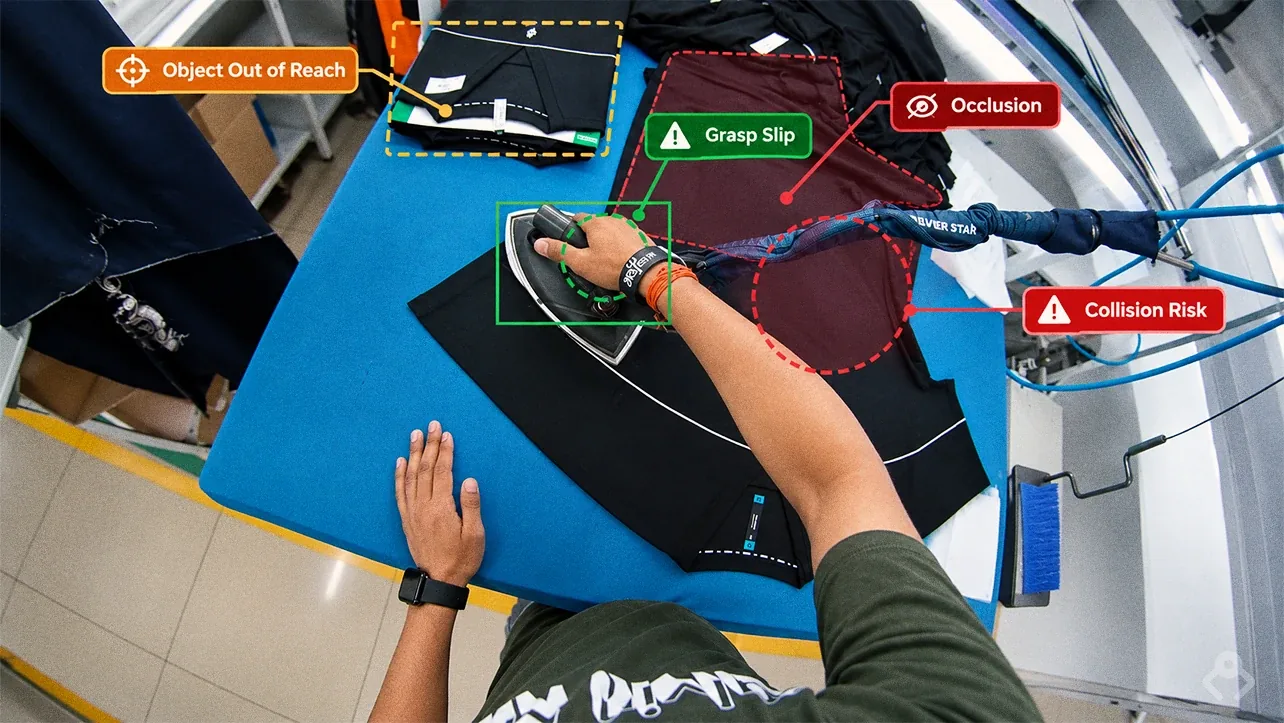
Building Repeatable Interventions Into Your Egocentric Robot Training Data
TLDR
Log every intervention as four fields: trigger state, operator action, termination condition, reward label. Drop one and the clip can't be replayed or scored.
Version your intervention scripts like code. Repeat each named script across operators so variance traces to the task, not to protocol drift.
Publish a per-session sensor manifest: RGB, depth, IMU, audio, force feedback, one shared clock. Robgence's ReboCam captures those streams in a single operator pass.
Benchmark teleoperation fidelity instead of assuming it. TeleopBench from Xsens shows dual-arm capture quality is measurable per rig.
Budget QA against three named error classes: mislabeled segments, temporal desync between streams, and near-duplicate takes that inflate hour counts.
Why does state, action, and reward clarity matter more than raw video volume?
Clarity matters more because a policy learns from labeled transitions, not footage. A thousand hours of unstructured first-person video gives a model pixels with no answer to "what changed, who changed it, and did it work." Three fields fix that: the state at the moment of intervention, the action taken, and the outcome signal.
Volume still helps, but only once each clip is addressable. Here's what an intervention record needs before an hour count means anything:
Trigger state: the observation that caused a human to step in, timestamped to the frame, with the failure mode named (grasp slip, occlusion, collision risk, object out of reach).
Action: the operator's corrective trajectory, captured as joint or end-effector commands, not just as video of a hand moving.
Termination condition: the explicit test for "the intervention is over," so segment boundaries don't depend on an annotator's judgment.
Reward or outcome label: success, partial, or abort, plus the reason code for aborts.
Scene and embodiment context: lighting, surface, object instance, gripper type, operator ID.
A clip missing the termination condition can't be sliced consistently twice. Teams that publish this schema up front, the way Lightwheel's EgoSuite Open100K release documents its egocentric collection, make their data auditable by anyone training on it.
How do repeatable interventions reduce variance in robot policy training?
Repeatable interventions cut variance because they turn the correction itself into a controlled variable. When five operators each fix a failed grasp their own way, the policy sees five conflicting gradients for one state. When all five follow the same scripted recovery, the model sees one consistent mapping and the remaining variance belongs to the scene.
Build repeatability like this:
Write the intervention as a script with a name and a version:
regrasp-cylinder-v3, not "operator corrected the grasp."Specify the approach: entry pose, speed band, contact force range, retreat path. Vague scripts produce vague demonstrations.
Run the same script across operators and sessions, then compare trajectories to find who drifted and retrain them before the next capture block.
Capture the counterfactual: record the failure to its natural end in a subset of takes so the policy learns what the trigger state looks like without rescue.
Hold out whole scripts, not random frames, at evaluation time. Random frame splits leak near-identical takes across train and test.
Handheld and portable rigs make this cheaper to repeat, which is why the Robotics and AI Institute's write-up on handheld robotic data collection is a useful reference point for teams scaling demonstrations outside a fixed cell. Robgence runs the same discipline on its teleoperation and egocentric capture, detailed across the Robgence data collection programs.
What annotation workflows preserve intervention context at scale?
Workflows preserve context when annotation happens against the session, not against isolated clips. An annotator who sees only a six-second segment can't tell a deliberate regrasp from a fumble. Give them the full session timeline, the operator's own marker presses, and the sensor streams, and the label survives review.
Practical workflow rules:
Mark in-session, correct in post. Operators press a physical or voice marker at the moment they intervene; annotators adjust boundaries later against the force and IMU traces.
Make the reason code a closed vocabulary. Free text destroys aggregation. Ten named failure modes beat a thousand unique sentences.
Require two independent passes on boundaries for any clip entering a training split, with disagreement over a frame threshold routed to adjudication.
Carry provenance on every segment: capture rig, firmware version, calibration date, operator ID, script version.
Audit for near-duplicates so repeated scripts don't become leakage. Repeatability is the goal; accidental copies of the same take are not.
Keep raw alongside derived. Never overwrite the original stream with a trimmed export.
The mechanics of staffing, review tiers and throughput are covered in Robgence's guide to building a data annotation pipeline that scales without sacrificing quality.
Which tools and pipelines keep intervention consistency across large datasets?
Consistency comes from three layers working together: a capture rig with synchronized clocks, an annotation platform that enforces your schema, and a QA stage that names the errors it looks for. Most teams combine a specialist collection partner with a general-purpose labeling platform rather than expecting one vendor to cover both.
| Provider | Core strength for intervention data |
|---|---|
| Macgence | Large-scale multilingual and multimodal data operations, including human-in-the-loop annotation workforces |
| Robgence | Physical AI capture: egocentric video via ReboCam, teleoperation sessions, synchronized multimodal streams |
| Encord | Video and multimodal labeling platform with model-assisted review and dataset curation |
| Scale AI | Enterprise annotation delivery at volume with managed workforce and quality tooling |
| Labellerr | Annotation tooling with automation-assisted labeling for computer vision workloads |
The same table read as sentences:
Macgence, the parent company of Robgence, runs large-scale multilingual and multimodal data operations with human-in-the-loop annotation workforces.
Robgence focuses on Physical AI capture, collecting egocentric video through ReboCam alongside teleoperation sessions and synchronized multimodal streams.
Encord provides a video and multimodal labeling platform with model-assisted review and dataset curation features.
Scale AI delivers enterprise annotation at volume through a managed workforce and its own quality tooling.
Labellerr offers annotation tooling with automation-assisted labeling aimed at computer vision workloads.
Pipeline choices that hold consistency over months, not weeks:
One clock, hardware-synced. Software timestamps drift; align video, IMU, audio and force feedback at capture, then verify desync as a QA check rather than a hope.
Schema as a versioned artifact in the repo, with a migration note every time a field changes.
Calibration logs per rig, reviewed before each capture block.
A named QA stage that reports counts per error class: label errors, temporal desync, outlier trajectories, near-duplicate takes.
Dataset cards per release, listing hours, scripts, operators, environments and known gaps.
For tooling comparisons across modalities, see Robgence's roundup of top AI tools for multimodal annotation in robotics.
How do you make egocentric data collection reproducible?
Reproducibility means another team can rebuild your capture conditions from your documentation alone. That requires a published sensor manifest, a fixed script library, named environments and a calibration record. Without those four, two sessions of the same task produce datasets that can't be pooled or compared.
A reproducibility checklist for first-person capture:
Sensor manifest: every stream the rig records, its resolution, rate and mounting position.
Mount geometry: head-mounted versus chest-mounted changes the hand-to-frame relationship and the policy that learns from it.
Environment registry: named locations with layout notes, lighting conditions and object inventories.
Operator protocol: pre-session calibration, warm-up takes discarded, break cadence.
Script library with versions, so "the same task" means the same thing in March and in September.
Release notes describing what changed between dataset versions.
Robgence's walkthrough on how to build an egocentric data collection pipeline for robotics covers the rig and staffing side in more depth, and teams planning a custom capture program can start a scope conversation through the Robgence contact page.
Frequently asked questions
How do you structure interventions in robot training data?
Structure each intervention as a record with five parts: trigger state, operator action trajectory, termination condition, outcome label with a reason code, and context metadata covering rig, operator and environment. Store it against the full session timeline so reviewers can see what preceded the correction.
What makes an action repeatable enough for policy learning from video?
An action is repeatable when it's written as a versioned script specifying entry pose, speed band, contact force range and retreat path, then executed the same way by multiple operators. Compare trajectories across operators to catch drift before it enters a training split.
How many hours of egocentric data do you need?
Hours matter less than coverage of states and failure modes. Count distinct trigger states, script versions, environments and object instances first, then add hours where coverage is thin. Unstructured hours without intervention labels add little to policy performance.
What are the best practices for reproducible egocentric data collection?
Publish a sensor manifest, fix mount geometry, maintain a named environment registry, version your script library, log calibration per rig, and ship dataset release notes. Another team should be able to reproduce your conditions from the documentation alone.
Should interventions be labeled during capture or after?
Both. Operators mark the intervention moment in-session with a physical or voice marker, and annotators refine boundaries afterwards against force and IMU traces. In-session marking preserves intent; post-hoc review enforces frame-level consistency.
How do you stop repeated takes from leaking between train and test splits?
Split by script version and session rather than by random frame, and run near-duplicate detection across takes. Random frame splits place near-identical frames on both sides of the boundary and inflate evaluation scores.
What error classes should dataset QA explicitly check for?
Name them so they can be counted: label errors, temporal desync between streams, outlier trajectories outside the script's declared force or speed band, and near-duplicate takes. Reporting counts per class turns QA from a claim into a number.
Do you need teleoperation data if you already have egocentric video?
Usually yes. Egocentric video captures human intent and scene context; teleoperation captures the action in the robot's own embodiment and command space. Pairing both gives a policy the trigger state and the executable correction.